



Principal Attorney
Companies involved in construction projects in the United States often face a common challenge.
“The project owner requested additional work, so we went ahead and completed it. Now they’re refusing to pay for the extra work. What should we do?”
Unexpected work and changes to the original design or scope of work are common in construction projects. To avoid delays and keep the project on schedule, contractors sometimes proceed with additional work under the understanding that the costs will be settled later.
However, when the time comes to request payment, the project owner may argue that the additional work was already included in the original contract or refuse to pay because a formal Change Order was never approved.
1. Changes in Scope Are One of the Leading Causes of Construction Disputes in the U.S.
The 2025 CRUX Insight Report, published by HKA, a global construction dispute consulting firm, analyzed claims and disputes involving 2,204 construction projects across 114 countries, identifying the leading causes of construction disputes.
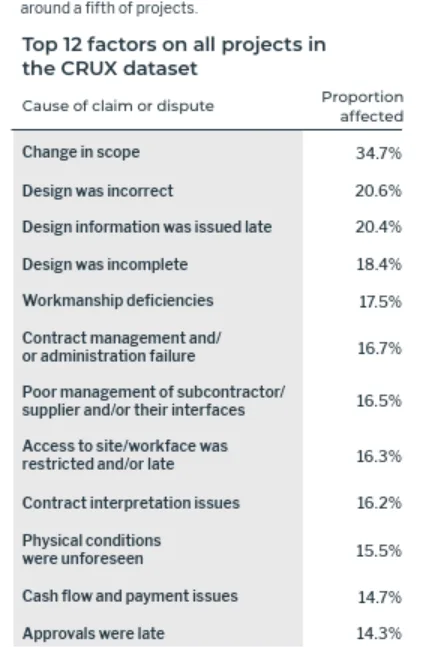
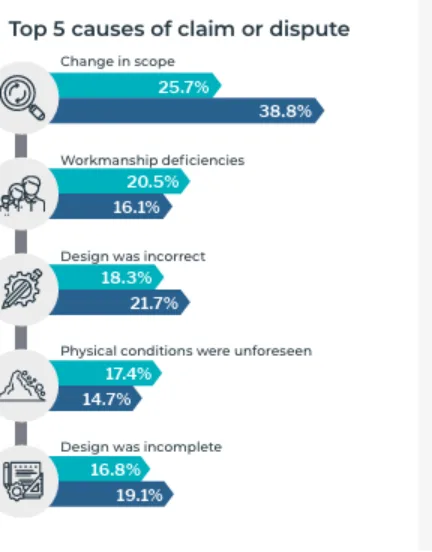
According to the report, the three leading causes of claims and disputes in the Americas, including North America, were:
- Change in Scope — 25.7%
- Workmanship Deficiencies — 20.5%
- Incorrect Design — 18.3%
Changes in scope are not a new challenge. HKA’s analysis shows that they have consistently ranked among the leading causes of construction disputes since before 2020.
Given the nature of construction projects, changes in scope are often unavoidable. Site conditions may evolve as work progresses, designs may need to be modified, or project owners may introduce additional requirements along the way.
The key, therefore, is not to eliminate changes altogether, but to effectively manage their impact on costs, schedules, and responsibilities. This is particularly important in North America, where changes in scope, workmanship deficiencies, and design errors remain the three leading causes of construction claims and disputes.
So, what can businesses do to minimize these risks and prevent changes in scope from turning into costly disputes?
1. Scope of Work: We Have Discussed It Countless Times, but It Is Worth Reviewing Again.
One of the most important provisions in any construction contract is the Scope of Work.
When the scope of work is not clearly defined, disputes can arise over whether certain tasks were included in the original agreement. The project owner may argue that the work was already covered under the contract, while the contractor may consider it additional work that requires separate compensation.
To minimize these disputes, businesses should clearly define what is included in the Scope of Work and what is specifically excluded during contract negotiations. It is equally important to establish how the Scope of Work relates to the project’s drawings and technical specifications.
However, even the most carefully drafted construction contract cannot prevent every change that may arise during a project.
This is where a well-defined Change Order process becomes essential.
2. Four Key Considerations in the Change Order Process
First, when and how must Notice of a change be provided?
If a construction contract requires Notice to be submitted within a specified period after a change becomes known, it is important to follow both the deadline and the required notification procedures.
However, these requirements are often overlooked in practice. Project personnel may verbally agree to additional work or exchange emails before proceeding, without submitting the formal Notice required under the contract.
This can become a problem when the contractor later seeks additional compensation. The project owner may refuse payment, arguing that the contractor failed to comply with the contractual notice requirements.
While exceptions may apply depending on the contract terms and applicable law, resolving these issues after the fact can require significant time and expense.
Second, who has the authority to approve additional work?
Not everyone who directs work on a construction site has the contractual authority to approve changes.
For example, a contractor may perform additional work at the request of an on-site Project Manager, only to discover that the contract requires written approval from a specific officer or authorized representative of the project owner.
In such cases, receiving instructions from an on-site representative does not necessarily guarantee payment for the additional work.
Businesses should therefore identify who has the authority to approve changes, understand the required approval procedures, and establish how to handle work that has not yet received formal authorization.
Third, changes in the Scope of Work should account for both additional costs and potential schedule impacts.
Changes in scope can affect more than just material and labor costs. Additional work may delay the overall project schedule or disrupt the work of other subcontractors.
However, contractors sometimes negotiate additional compensation without securing a corresponding extension of time.
As a result, even after completing the additional work, they may face liquidated damages or other contractual liability if the project is not completed by the original deadline.
For this reason, Change Orders should address both financial adjustments and any necessary extensions to the construction schedule.
Fourth, businesses should consider Risk Allocation when changes to the Scope of Work have not been formally approved.
There may be situations where delaying or refusing additional work could disrupt the entire project or lead to even greater losses.
To address these risks, construction contracts should establish clear procedures for emergency work, change directives, reservation of rights, and the reconciliation of additional costs.
Another important consideration is contract enforcement.
Many clients invest considerable time and effort negotiating their contracts and addressing potential risks before signing. However, once construction begins, they may fail to properly exercise or protect the contractual rights they worked to secure.
For clients we advise on an ongoing basis, preparing for these situations in advance is typically part of our legal counsel.
When a change in scope occurs, promptly issuing the required Notice and following the appropriate contractual procedures can help preserve the contractor’s rights and reduce the risk of future disputes over notice requirements and additional compensation.
3. The Importance of Contract Enforcement
One issue I consider particularly important when reviewing construction contracts and disputes is how businesses enforce their contractual rights throughout a project.
Many companies invest significant time and resources in negotiating contract terms before signing. They work with attorneys to review agreements, revise unfavorable provisions, and secure their rights to additional compensation when changes arise.
However, once construction begins, these carefully negotiated procedures are not always followed.
A contract may require written Notice, yet the parties rely on verbal discussions. A Change Order may require formal approval, but the contractor proceeds with additional work to avoid delaying the project. Additional costs may arise, but rather than documenting or claiming them promptly, the contractor waits until the project is completed to settle everything at once.
As a result, businesses risk losing the protections they worked so hard to secure during contract negotiations.
Having a well-drafted contract and effectively protecting your rights under that contract are two different things.
Of course, failing to follow contractual procedures does not automatically mean that a contractor loses the right to claim additional compensation. The outcome may depend on the applicable state law, the specific contract terms, and the conduct of the parties involved.
What matters is understanding the contract’s Notice Requirements, submitting the necessary notices on time, and following the proper procedures to preserve rights to additional compensation and extensions of time.
When disputes arise over additional construction costs, businesses should also raise objections or reserve their rights in accordance with the contract, while maintaining proper records and documentation to support potential future claims.
These steps do not necessarily require costly legal proceedings. In many cases, a timely Notice or a properly prepared Change Order can help prevent a much larger and more expensive dispute down the road.
This is particularly important for Korean companies entering or operating in the U.S. construction market.
These companies should establish clear decision-making processes between their headquarters in Korea and their U.S. project teams, identify who has contractual approval authority, and ensure that local project management procedures are properly established.
Construction projects often require quick decisions on-site. However, protecting contractual rights requires that those decisions be supported by the appropriate procedures and documentation.
For companies involved in construction projects in the United States, drafting a strong contract is only the first step. Equally important is establishing internal systems to manage changes as they arise and ensure that contractual procedures are consistently followed throughout the project.
While a well-drafted contract is the foundation of dispute prevention, even a most well drafted contracts get litigated all the time. Consistent enforcement and management of that contract throughout the construction process ultimately helps construction companies to prevail.
Sul Lee Law Firm advises businesses involved in construction projects across the United States on construction contract review and negotiation, ongoing legal matters during construction, Change Order and additional compensation disputes, construction payment claims, and construction litigation.